The story of Ntingwe Tea Estate began as early as 1893 as narrated by Irene Stewart who is grand-daughter to Elias Titlestad. This was after Mr. Titlestad procured a 99-year lease of 100 acres of land from government during the apartheid era. On a portion of this land, Mr. Titlestad established a thriving trading store, one of several in the district, to meet the needs of local people. In 1905 when land was divided into farms, he applied for the site on which his trading store stood and duly paid for the farm Ntingwe on which he developed a disease-resistant breed of cattle, Afrikander cross Pol, the Afpol.

Mr. Titlestad’s son (Irene Stewart’s father) was born during the 1900’s, him and his siblings and spouses spent many years on the farm and other adjoining farms where they grew up. As kids, they spent many happy hours roaming the hills of Ntingwe, ploughing fields, herding cattle, fishing in streams and hunting for the ‘Ntingwe lily’ after which the farm was named. In the 1960’s there came a crunch for forced removals, enforced by apartheid laws such as the ‘Group areas Act’, where they had to move from Ntingwe or be turned off the property penniless.

On the other hand, during the era of forced removals, the local people were also moved away from Ntingwe and adjoining farms to make way for Izigqoza communities who were forcibly removed from farms around the towns of Weenen and Estcourt as they were deemed “superfluous to the labour market” by the then apartheid government. The Izigqoza communities were shipped in buses and forced to relocate around the Ntingwe farm, the area that was originally occupied by AmaChube and the Xulu people. As a result, the Ntingwe farm which later evolved to the Ntingwe Tea Estate is surrounded by three tribal communities that are organised under three separate tribal authorities, which are Izigqoza Tribal Authority led by INkosi Zulu, AmaChube Tribal Authority led by INkosi Shezi, and Mvutshini Tribal Authority led by INkosi Xulu.

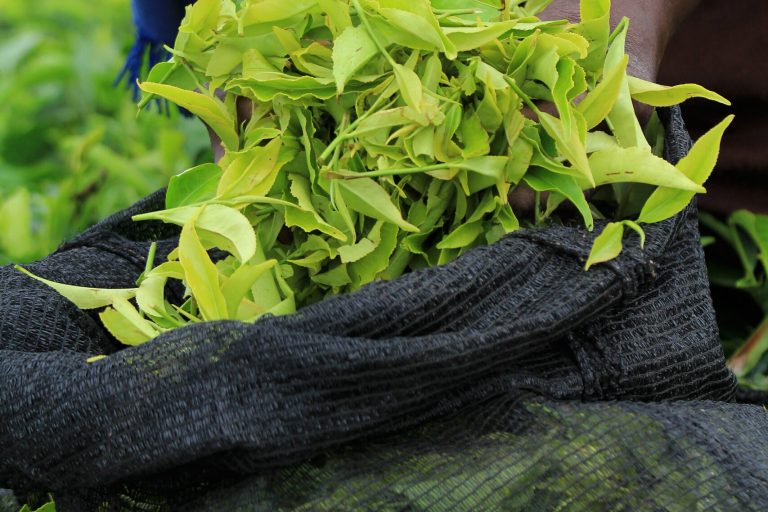
Black tea is made by harvesting of good quality leaf, weighed, fluffed, and withered and processed after a minimum of eleven hours of withering and on the following day is, crushed to produce primary and secondary grades. The Ntingwe’s two tea producing plants, one for black tea and the other for green tea, use modern technology available to produce superior quality teas. Black tea is Cut, Tear and Curl (CTC) type and green tea, low caffeine process using technology from Japan.

NTINGWE TEA

Ntingwe Tea Estate lies in a deep rural area approximately 34 kilometres from Nkandla town, and approximately 65 kilometres from Kranskop.  The property where Ntingwe Tea Estate is located falls under the ownership of the Ingonyama Trust and Ntingwe holds a long-term lease from the entity. Ntingwe Tea Estate falls under municipal boundaries of the Nkandla Local Municipality and King Cetshwayo District Municipality.


Planting tea at Ntingwe commenced in 1987 and evolved from an initial 50 Hectares research project, this project was initiated in 1987 by the KwaZulu Finance and Development Corporation (KFC) (now IThala) and later partnered with the KwaZulu-Natal Department of Agriculture and Rural Development (DARD). The main aim of the project is to create employment, facilitate the general socio-economic development of the surrounding areas and so enable its eventual privatization to achieve BB-BEE, as well as to develop small holder tea producers in the long term.


Trials were very successful and proved that this locality was highly suited to produce superior quality teas. In 1993, a decision was taken to finally develop Ntingwe Tea Estate and establish a 600 hectares plantation of tea by the year 2004. A full processing factory with two fully functional processing lines was put in place. In 2009 DARD committed funding for the erection of a fully functional green tea plant with the latest green tea processing technology from Japan, thus making Ntingwe Tea Estate the only green tea processing factory in the country. The Estate was originally 600 hectares (ha) in extent however, only 425 hectares were planted.  Of the total hectares planted only 395 hectares remain under production. This is the first tea venture in South Africa that was aimed exclusively at the export market, setting a huge challenge as a pioneer in the South African Tea Industry.

IMG_0128

PROJECT MILESTONES TO DATE

2000

Ntingwe Tea was ranked among the Top 5 Best Teas in the world by Taylors of Harrogate in the early 2000’s.

2000

Ntingwe Tea successfully set up a green tea processing plant, the only green tea processing factory in the country

2005

Ntingwe Tea Estate produced high quality tea which was sold in bulk on the London Tea Market over the past years from its initiation up to 2005.

2012
Ntingwe Tea was sold at Woolworths Food Retail until 2012 as a high quality product, and aims to reintroduce the brand back into market and expand to other retail outlets.

PROJECT MILESTONES TO DATE

2000

Ntingwe Tea was ranked among the Top 5 Best Teas in the world by Taylors of Harrogate in the early 2000’s.

2000

Ntingwe Tea successfully set up a green tea processing plant, the only green tea processing factory in the country

2005

Ntingwe Tea Estate produced high quality tea which was sold in bulk on the London Tea Market over the past years from its initiation up to 2005.

2012
Ntingwe Tea was sold at Woolworths Food Retail until 2012 as a high quality product, and aims to reintroduce the brand back into market and expand to other retail outlets.